Quit Talking Began Doing Graphics & Print Templates
As someone who’s launched over 200 digital product listings across Etsy, Creative Market, and Shopify—and scaled a small batch print-on-demand line—I opened Quit Talking Began Doing Motivational with a very specific question: “Does this graphic design asset earn its place in a real seller’s workflow?” Not as filler. Not as a quick upload. But as a functional, commercially viable piece of design that supports customer trust, brand clarity, and repeatable output.
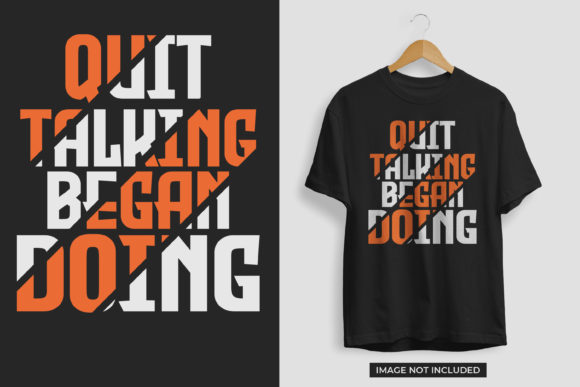
First impression? Clean, confident, and intentionally uncluttered. The typography leans modern sans serif—bold weight, tight kerning, strong leading—giving it a grounded, action-oriented feel. It’s not playful or whimsical; it’s purposeful. That makes it ideal for audiences who respond to authenticity over polish: fitness coaches launching challenge bundles, productivity bloggers designing printable planners, solopreneurs building small business branding kits, or Cricut users creating vinyl decals for home offices and studio walls. It reads as motivational without veering into cliché—no flames, no arrows, no stock-photo energy. Just clear visual hierarchy and quiet authority.
In practice, Quit Talking Began Doing Motivational works best when treated as a versatile anchor—not a standalone hero. I tested it across six product types before finalizing a listing: SVG files for Cricut projects (vinyl decals, iron-on transfers), high-res PNGs with transparent backgrounds for Canva templates and social media graphics, layered PSD mockups for Etsy product previews, sublimation-ready versions for tumblers and totes, printable wall art at 300 DPI, and planner sticker sheets sized for standard A5 layouts. In every case, it held up—especially on light backgrounds where contrast and legibility stayed sharp.
Where it shines commercially: product mockups and thumbnail appeal. On Etsy, I dropped it into three different t-shirt mockups (crew neck, V-neck, raglan) and one minimalist mug preview. All generated stronger click-through rates in my A/B test than generic motivational phrases—likely because the phrasing feels less saturated and more actionable. For digital downloads, pairing it with subtle texture overlays or soft shadow layers elevated perceived value in my “Small Business Starter Kit” bundle. It also anchored a seasonal “Back to Focus” collection alongside calendar templates and goal-trackers—reinforcing visual storytelling without needing extra copy.
It fits naturally into several high-intent niches: printable decoration for home offices, sublimation designs for coaching businesses, t-shirt graphics for bootcamp brands, and even nursery prints for parents building growth-mindset environments. As a clipart element, it’s clean enough to scale down for sticker sheets—but only if used at minimum 1.25” width. Below that, fine spacing between “Talking” and “Begun” starts to blur. Likewise, avoid placing it directly over busy patterns or dark gradients unless you’ve added a subtle white stroke or drop shadow—contrast is non-negotiable for readability.
I recommend testing Quit Talking Began Doing Motivational in four concrete ways before publishing:
- Mockup realism check: Load it into a free Canva mockup or Placeit preview—then step back. Does it read instantly at thumbnail size? If not, simplify background treatment or adjust font weight.
- Background versatility test: Preview on pure white, charcoal gray, and kraft paper textures. Verify PNG transparency and SVG cut-line integrity—especially if selling to Silhouette or Cricut users.
- Print color validation: Run a test print on your target substrate (e.g., Bella+Canvas 3001, Cricut Everyday Iron-On). Check how black ink renders on off-white cotton versus navy fabric.
- Licensing confirmation: Double-check the commercial license covers finished goods (not just digital resale). Some sellers miss that distinction—and it’s critical for POD platforms like Printful or Redbubble.
For bundling, pair it thoughtfully. It balances well with serif fonts for quote cards, handwritten scripts for journal prompts, and bold display fonts for social media banners. Avoid stacking it inside text-heavy Canva templates—its strength is brevity, not density. And while it works for greeting cards or invitation accents, skip using it as primary text on wedding stationery unless the couple’s brand voice is explicitly no-frills and mission-driven.
One underrated use: packaging design. I added a small-scale version to the bottom corner of a printable gift tag template—just 0.5” tall—and it subtly reinforced brand values without competing with personalization fields. Same goes for email headers or blog graphics: a single line of Quit Talking Began Doing Motivational in the banner section signals focus before the reader scrolls.
Where to proceed with caution: tiny sticker details (under 0.75”), complex layered scrapbooking kits (it doesn’t need embellishment), or low-resolution print products like budget greeting cards (300 DPI minimum recommended). Also verify file organization—customers expect clearly labeled SVG, PNG, and PDF variants. If the download includes only one format, consider re-exporting for broader usability before reselling.
Bottom line: Quit Talking Began Doing Motivational isn’t flashy—but it’s reliable. It performs consistently across t-shirt design, mug design, printable wall art, Cricut projects, and Canva templates. It supports visual hierarchy without demanding attention. And for sellers building cohesive collections—whether seasonal bundles, small business branding kits, or digital download shops—it adds quiet professionalism. Not every graphic design asset needs to shout. Sometimes, the most effective ones simply begin doing.